


By Jordan Fouts
The Elkhart Truth
GOSHEN, Ind. — Public mental health crises that are successfully diffused by first responders often aren’t the ones that you hear about.
For Leah Garbode , a training program for police officers and firefighters who respond to such crises in Elkhart County has proved invaluable.
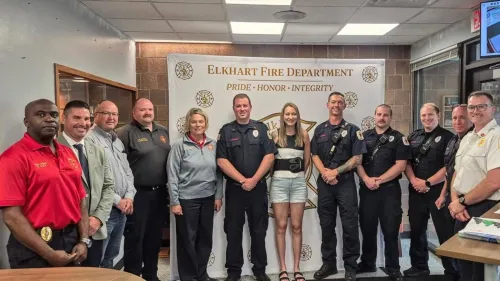
Elkhart County Court Services hosted a graduation ceremony for 26 first responders from seven agencies who completed a weeklong Crisis Intervention Team training course. The 40-hour course helps prepare them for encountering individuals experiencing a mental health crisis.
Garboden said she’s grateful to now serve on the steering committee for the CIT program after having positive experiences with officers who completed it. She said she hopes other cities will adopt the program, which is recognized internationally.
“The reason why I love CIT is because, I deal with mental health (issues) and I’ve had to have a few interactions with police officers. The officers I had interaction with really understood what I was going through and helped me in the situation when I was really struggling, when other people couldn’t help me in that situation,” Garboden said Friday. “People living with mental health (issues), they need all the support they possibly can get. If it’s one person who’s willing to listen to them, that would mean a lot.”
Garboden helped lead a unit on “Hearing Distressing Voices.” Other topics included de-escalation, suicide prevention and substance use disorder.
“It’s really hard living with mental illness. I think it’s especially hard for family members, too, because they don’t always understand what you’re going through,” Garboden said. “I’ve known people who’ve had very negative experiences with officers.”
The class also visited places in the community that offer services to people with mental health issues, including the Oaklawn Crisis Center and the Lexington House .
Monica Ramirez and Susan Pingel , both social workers with the Elkhart Police Department , said they were glad to see so many EPD officers taking the course with them. The two go out on calls alongside officers in certain situations and follow up with the individual in crisis, to help meet medical, mental health or other needs.
“We co-respond with officers. We’ll go out on scene, and really our clientele is whomever the officers interact with,” Pingel said. “So that’s a lot of mental health, a lot of domestic battery, juveniles, elderly, literally whoever has a social issue. A lot of times officers will go out on calls and it’s not necessarily criminal, but clearly they need assistance. So that’s kind of where we bridge that gap between law enforcement and local agencies around the area.”
She said the course offers a standardized form of training to get everyone on the same page.
“Obviously, they are much more geared toward safety, criminal justice. We are a lot more on the emotional and social side of things,” Pingel said. “But getting the standardization of training on a middle ground is really helpful.”
Ramirez said the course was an opportunity to learn more about the role each agency plays when responding to a crisis, and about how they can best help each other.
“I think probably the best opportunity in this training specifically for our positions is being able to use those skills and practice those skills side-by-side with the officers. When we’re responding, here’s what we need from you, what do you need from us?” she said. “It’s just kind of eye- opening on all sides.”
More than 330 people have completed CIT training since it was first offered in the county in 2016, according to John Antonucci , chief probation officer in the adult division of Elkhart County Court Services. February’s course was geared toward first responders while another one in fall will focus more on community partners.
The program helped lead to the formation of Goshen’s Mobile Integrated Health unit last year, according to Elkhart County Judge Teresa Cataldo. The MIH brings together a multidisciplinary team of paramedics, clinicians and officers trained in mental health.
“The officers that started that came through CIT, what they’ve done is built on the certification to also integrate police and fire together, and social workers, to respond together,” said Cataldo, another steering committee member. “That’s what we’re hoping either other cities will start doing in the county, or ... we have a mental health unit, where they get dispatched wherever the need arises.”
She said situations that are successfully de-escalated are the ones that don’t draw headlines. Often the person experiencing a mental health crisis just wants someone to listen to them, she said.
“The benefits are what you don’t see. Because if de- escalation works, it doesn’t get in the paper. You don’t hear something on the news, you don’t see something in the headlines, because everybody goes home safe,” Cataldo said. “When de- escalation either isn’t used or doesn’t work, that’s when it gets in the paper.”

© 2026 The Elkhart Truth (Elkhart, Ind).
Visit www.elkharttruth.com.
Distributed by Tribune Content Agency, LLC.