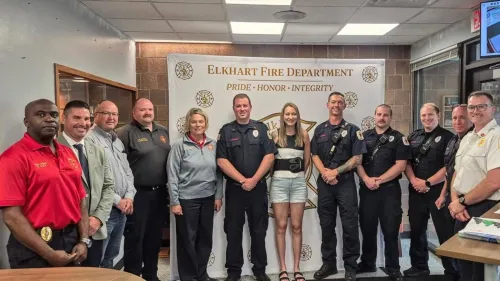
The newly formed Mineral County Emergency Medical Service serves the first rural county in West Virginia to begin carrying blood products to treat life-threatening, severe bleeding before a patient reaches the emergency department.
According to Dr. Catherine Kirbos, the county’s EMS medical director, the program was inspired by multiple instances in which patients required blood products for best care, while the county could only rely on air and flight programs for this life-saving intervention, which presented challenges.
Watch on demand: Bringing whole blood to the front lines of EMS
“Mineral is the first rural county in which we have been able to establish the program,” said West Virginia Office of EMS Medical Director Dr. P.S. Martin. “It is our hope that we can work with blood banks supplying West Virginia’s critical access hospitals to increase blood supplies to those facilities and that they will be able to share with their local, rural EMS agencies.”
The program is a partnership between Mineral County EMS and WVU Potomac Valley hospital, according to Martin.
“WVU Potomac Valley Hospital was pivotal in us being able to do this program, specifically CEO Mark Boucot,” Mineral County Emergency Medical Service Chief Lauren Trenter said. “From day one, he asked what he could do to help us and took the lead into making the program a reality. The hospital donated equipment to the program to ensure its success.”
“Left with no alternative”
The Mineral County Emergency Medical Services Cam Duncan Prehospital Blood Initiative — named after a local teenager who received blood in a non-traditional way in 2024 —officially started on Feb. 2, 2026
On the morning of Sept. 17, 2024, emergency personnel were dispatched for a serious vehicle crash with a victim trapped inside.
Trenter recalled arriving on the scene of the crash and determining the victim was seriously injured.

Cam Duncan, a young man suffering severe traumatic injuries, needed blood, Trenter said.
Maryland State Police Aviation Command Trooper 5 was requested to the scene but could not fly due to weather.
“We were left with no alternative but to obtain blood products by unconventional means,” Trenter said. “Due to the rain and fog on that particular morning, airflight was denied for safety by multiple aeromedical agencies.”
Having already instituted the use of blood products in Maryland. Trenter’s knowledge of the resources surrounding her, led her to request additional blood products to be brought by ground from the helicopters base, located at the Cumberland Regional Airport. For the first time, responders requested blood products directly from WVU Potomac Valley Hospital.
“There was no process in place to make that happen, nor had it been done before,” Trenter said.
Trenter said that with persistence, life-saving whole blood was delivered directly to the scene from Potomac Valley Hospital before the ambulance departed for UPMC Western Maryland in Cumberland, the closest Level III trauma center.
The ground ambulance transporting Duncan rendezvoused with the trooper/medics enroute to the hospital and continued administering blood products, according to Trenter.
“In an unconventional method of obtaining blood products, Duncan was able to receive blood that day, which ultimately aided in saving his life,” Kirbos said.
“Our trooper/medics adapt to whatever challenges stand in the way of patient care,” Maj. Michael Tagliaferri, aviation commander for the Maryland State Police Aviation Command said. “Since 2023, troopers have delivered whole blood by ground on 17 occasions when flight was not an option.”
MSP Aviation Command is the only neighboring agency or county carrying blood products.
The flexibility that day and determination “reflected the resilience and innovation our teams bring to emergency medicine every day,” Tagliaferri noted.
Kirbos said that this event highlighted the gap in the prehospital treatment of hemorrhagic shock in the area, as well as other rural areas in the state — leading to the initiative to obtain prehospital blood for the community.
Mineral County EMS services over 27,000 residents and spans more than 300 square miles, in the eastern panhandle of West Virginia.
In response to Duncan’s crash, the West Virginia Office of EMS tasked the providers in Mineral County directly involved in his incident to develop a prehospital blood program and subsequently initiating it — named to honor Duncan, according to Trenter.

(Left to right) Pilots-in-Command Casey Love and Kamara Makari, and flight medics Trooper First Class Eric Arnold and Trooper First Class Justin Marlatt of the Maryland State Police Aviation Command. Regional air medical and public safety partners play a key role in supporting trauma care and blood product delivery for rural EMS agencies.
(Photo/Courtesy Todd Bowman)
Benefits of prehospital blood products
Historically, the only option that local EMS clinicians had was to give IV fluids, Trenter said. EMS was relegated to treating severe, uncontrolled bleeding with “two large-bore IVs running wide open.”
“This practice was debunked time and time again,” Trenter added. “That practice was making patients sicker by the time the patient reached an emergency department by diluting the remaining clotting factors.”
“Think about it this way — our body bleeds blood, not water,” Kirbos said. “It is best to replace blood with blood, not replace blood with water.”
Trenter attributes much of the advancement of treating trauma patients within the United States to techniques that military soldiers have learned on the battlefield.
“Battlefield medicine quickly showed how field transfusions of blood instead of crystalloid solutions drastically reduced mortality rates of soldiers,” Trenter said.
This knowledge became the foundation for pushing whole blood or blood products to the street for more timely care of hemorrhagic shock patients and has been proven time and time again by data-driven analysis.
| MORE: Barriers to prehospital whole blood implementation
Administering blood products in West Virginia
In West Virginia, to administer blood products in the field, you are required to have a two-person team, according to Kirbos.
This team must consist of one paramedic who clinically evaluates the patient, assesses their need for blood and determines if the patient meets the requirements and beings the initiation process.
Kirbos shared the state medical director recently updated the protocol, which initially required two paramedic level clinicians, to now require one paramedic and one additional clinician of a differing certification including EMT-B, EMT-A or another paramedic.
The lack of advanced providers in West Virginia contributed to the decision, Kirbos said. “This change to the guidelines for prehospital blood initiation is in direct response to the need for this life-saving intervention to be available throughout the state, even in our most rural areas where it may be near impossible to have two paramedics on scene.”
West Virginia was the first state to implement comprehensive, statewide protocols for administering whole blood in ambulances to treat severe traumatic, obstetric and gastrointestinal bleeding, initiated by Cabell County EMS in November, 2023, followed by Harrison County EMS in March, 2024, and Monongalia EMS in April, 2025, according to Martin. Camden Clark EMS, the WVU EMS Physician Response program and Mineral County in followed in February, 2026.
“Berkeley County EMS will hopefully be in the near future,” Martin said. “Our original plan was to have agencies along the interstate corridors to each of the major (trauma) centers carry blood products, so that agencies transporting patient to those facilities can be met with blood products while en route, if necessary.”
Martin noted, “there is also a possibility that a new, break-through in spray dried plasma, shown to be equal to whole blood for early resuscitation of severely injured, patients may soon be FDA approved.”
“The new product has a shelf life up to a year unrefrigerated,” Martin said. “It will be a game changer for our rural EMS agencies, if FDA approved.”