

By JJ Hensley
The Arizona Republic
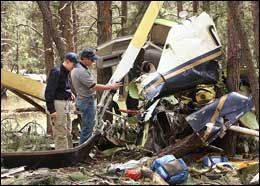 AP Photo/Ross D. Franklin, Pool National Transportation Safety Board and Federal Aviation Administration workers survey the damage left by the crash of two medical helicopters Monday, June 30, 2008, in Flagstaff, Ariz. A total of six persons died and one victim is still critical from the mid-air collision on Sunday as one helicopter ferrying a patient with a medical emergency from the Grand Canyon collided into another chopper carrying a patient, Sunday east of Flagstaff Medical Center, but officials said they were unable to provide an account of what preceded the crash. |
FLAGSTAFF, Ariz. — For Kelly Stopka, the scenario that played out in Flagstaff airspace was all too familiar.
Stopka, 39, a flight nurse based in Tucson, survived a medical-helicopter crash in Apache Junction in December 2004 that left the paramedic, Doreen Johnson, dead, and the pilot, Susanna Corcoles, with severe injuries.
“We’re all looking out for safety and everybody’s looking out for each other,” said Stopka, who returned to her job about six months after the crash. “Unfortunately, there are occasions when this stuff happens and it hits close to home.
“Sometimes on a good day, things can go wrong.”
Experts in the industry say there’s risk inherent in flying the missions, which can take pilots to remote areas with rugged terrain and unknown weather conditions. Still, plenty of checks are in place to keep such tragic accidents from happening.
Emergency medical crews fly nearly 1,400 missions each day. Most rely on the pilot and crew to maintain a constant awareness of what’s going on outside the helicopter.
It’s the same “see and be seen” system Curtis Walker used when he started flying helicopters in Arizona in the early 1970s.
“Just like there are blind spots in the car, with structures in the car, there are places like that in the helicopter,” Walker said. “They’re very dangerous in ‘see and be seen’ concepts.”
Crews scramble to the helicopter as soon as a call comes in from a local law enforcement or fire agency requesting urgent help transporting a patient to a hospital.
The pilot and medical team constantly are assessing whether it’s safe to fly in to pick up the patient; any member of the crew can voice concerns and cancel the mission at anytime, said Jonathan Collier, a spokesman with Air Evac Services.
The industry standard requires that the pilot be kept in the dark about the patient’s condition as much as possible to prevent the urge to cut corners in an effort to save a life.
Team members are in communication with firefighters or officers controlling the landing zone from the time they leave the hangar to the time they touch the ground to pick up the patient. Once the helicopter lifts off, the crew talks with security officers at the destination hospital and should maintain radio contact with other traffic in the area.
Scenarios that bring more than one helicopter to a hospital in the same time frame are relatively rare.
Scottsdale Healthcare Osborn has had as many as 10 flights a day come into one of its three helipads on site. The pilots typically do a flyover, said Nancy Hicks-Arsenault, director of emergency services at the hospital. The pilot will hover in place until it’s safe to land if another aircraft is on the helipad.
“One thing we count on is very good communication when the helicopters are bringing us patients,” she said.
The Flagstaff crash was the only time in the past 25 years when two emergency medical-services helicopters collided. Even with an infinitesimal number of medical flights that crash into each other, industry advocates say there is room for improvement.
“We believe one accident is too many,” said Dawn Mancuso, executive director of the Association of Air Medical Services. “Like any intervention with the medical field, there are some risks associated.”
The midair collision Sunday marked the second time in three days that Arizona emergency helicopter crews didn’t make their final destinations. Less than 48 hours earlier, an Air Evac helicopter crash-landed near Ash Fork, about 30 miles outside Prescott, injuring its crew of three.
The deadly crash was the ninth time in the past six months that a medical helicopter crashed somewhere in the United States; 23 people have died and nine have been hurt in those accidents.
Chairman Mark Rosenker said Monday that the National Transportation Safety Board was concerned about the “disturbing” trend of air-medical accidents that have occurred in recent months.
As NTSB officials investigate the cause of the crash, area medical transportation companies are doing a reassessment of their own, Air Evac’s Collier said.
“Anytime something like this happens to one of our aircraft or others, we take time to evaluate as much as we can,” he said.
One of the brightest hopes is the Automatic Dependent Surveillance-Broadcast, a system that will allow pilots to see other aircraft and weather conditions from the cockpit without relying on air-traffic controllers, a crucial addition for air-medical flights which can often occur in areas without an airport nearby.
Until that technology is in place on more flights, helicopter pilots will continue to rely on the “see and be seen” system.
Authorities will spend the coming weeks and months trying to determine why or how that communication broke down on Sunday, but Stopka, who survived the 2004 crash, said that it’s hard to explain just how hectic things can be when bringing in a patient who is critical.
“It’s kind of organized chaos when you’re doing that,” she said. “I want people to understand, a lot of times it’s not that people aren’t being safe, it’s just that weird things can happen.”
Republic reporter Kate Nolan contributed to this article.