

By Anne Krishnan
The News & Observer (Raleigh, North Carolina)
Copyright 2007 The News and Observer
Critically ill and injured patients in Eastern North Carolina will have more and faster options for care by the end of the year.
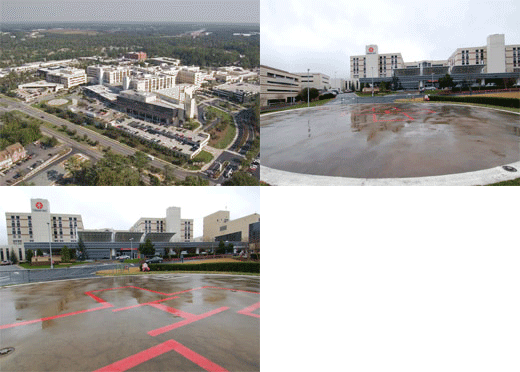 PHOTOS COURTESY WAKEMED.ORG Wake County, N.C., emergency medical teams have typically transported patients by traditional ambulances, but the growing population and increasing gridlock have made that more difficult. As of Thursday, WakeMed won approval to implement air ambulance services, which will provide patients with more transportation options. |
That’s when WakeMed expects its new air ambulance service to lift off.
The service, which won approval from the state Thursday, could transport at least 530 patients in its first year.
That will certainly include touching down at major traffic accidents, but the service also would help shuttle stroke patients and sick infants from rural hospitals to medical centers where they can get specialists’ care.
“This changes the face of Wake County health care forever,” WakeMed CEO Bill Atkinson said Thursday. “This is a lifesaving service.”
Wake County’s emergency medical teams have typically transported victims of car wrecks or heart attacks by traditional ambulances, but the growing population and increasing gridlock have made that more difficult, said Brent Myers, medical director for Wake County’s emergency medical services.
The county’s emergency services have called on helicopters from UNC Hospitals and Duke University Medical Center occasionally, but those hospitals are too far away to always be practical, Myers said. WakeMed’s proximity to patients in Wake County will be critical, he said.
“If you have a helicopter a five-minute flight time away or a 15-minute flight time away, that makes a difference,” he said.
WakeMed’s helicopter will be used for the most serious, life-threatening cases, when quick transportation is essential to patient survival, Atkinson said.
The hospital expects about 40 percent of its flights to serve patients in Wake County. Another 42 percent would come from Sampson, Harnett, Wilson, Wayne, Nash, Johnston, Franklin and Lee counties.
Atkinson wanted to add air service at WakeMed even before he arrived at Wake County’s largest hospital three and a half years ago. He said he has seen the positive effect that medical helicopters can have.
After Hurricane Floyd, an air ambulance program he started at New Hanover Health Network in Wilmington helped rescue ill and injured people in flooded Pender County who would have been unreachable by road, he said.
 WakeMed CEO Bill Atkinson |
“In the piece of art that is Wake County, it was very clear this color of paint was missing,” Atkinson said. “Gosh, this was a gaping technological absence.”
Although the need might have been obvious to Atkinson, the path to approval wasn’t straightforward. WakeMed’s first application for air ambulance service was turned down in early 2005.
Since then, the hospital has received Level 1 trauma status, which indicates that it provides the highest level of emergency medical care a patient can get in a North Carolina hospital.
It convinced the state to change a rule prohibiting new medical helicopters within 60 miles of an existing program. Duke is 22 miles away from WakeMed and UNC is 24 miles away. Both hospitals have had their services since the mid-1980s, before the 60-mile rule was implemented.
Five of the state’s eight medical helicopter programs — including Duke and UNC — opposed the rule change, arguing that it would lead to overcrowding in the air ambulance industry. The hospitals challenged WakeMed’s claims about the need for the service.
In emergency services and other matters, Wake County has become a highly competitive health-care market, with WakeMed battling its counterparts to the west for market share.
Atkinson downplayed the competitive aspects of adding helicopter service, but said the service will help solidify WakeMed’s position as a leader in the state."We were in the major leagues to begin with, but sometimes people don’t always notice that,” he said.
WakeMed has the second-busiest emergency department in North Carolina, behind Carolinas Medical Center in Charlotte, with 118,546 patient visits in 2005. Another 40,460 patients visited the emergency room at the WakeMed Cary campus.
The health system has three helipads already: two at its central campus and one at the Cary hospital. It expects to eventually build helipads at each of its locations, including the free-standing emergency department in North Raleigh and upcoming facilities in Apex and Knightdale.
WakeMed must now recruit and train its medical crews and select the helicopter. Omni Flight Helicopters of Texas will own the aircraft and employ the pilots. WakeMed will lease the helicopter and provide the medical crews.
The hospital expects to have about $1.2 million in startup and capital costs in the air service’s first year. The ongoing costs of the service will be about $2.4 million a year, including leasing the helicopter, staff salaries, fuel costs and insurance, hospital spokeswoman Heather Monackey said.
WakeMed and Omni Flight will share the ongoing costs, she said, but she couldn’t be specific about how much WakeMed would spend. The hospital’s annual budget is about $980 million.
The hospital expects to generate a small profit on the service within the first year.